


At the suggestion of the CNC, during the Cannes Film Festival, an agreement was signed between the Government of the Republic of Latvia and the Government of the French Republic on film co-productions in order to promote cooperation between the two countries in the film sector, promoting the development of co-productions and the international competitiveness of the creative industries of both countries.
Published: 21.05.2026.
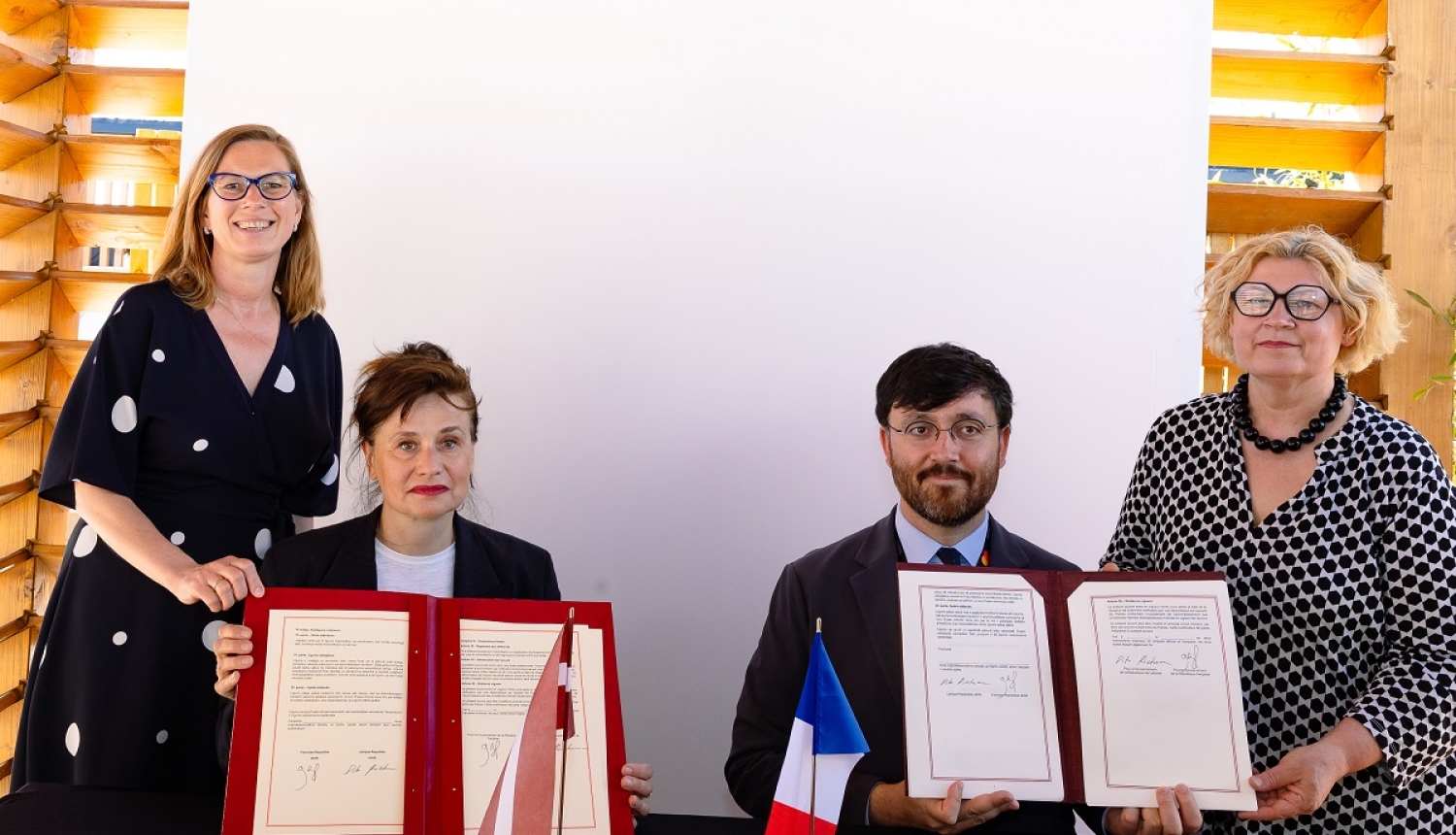
Latvijas un Francijas sadarbības līgumu parakstīja Francijas Nacionālā kino centra direktors Gaetāns Briels un Latvijas Nacionālā kino centra vadītāja Dita Rietuma, piedalījās LR Kultūras ministrijas valsts sekretāre Dace Vilsone un Latvijas vēstniece Francijā Alise Balode. Foto: Agnese Zeltiņa
The signing of the agreement will help strengthen cooperation between France and Latvia in the field of cinema; interest in such cooperation has been especially heightened after the global success of the Latvian, French and Belgian co-production, the full-length animated film “Flow / Straume” (2024) – in 2025, the film became the internationally most popular French film / co-production. The Agreement sets out the main principles to be observed by the competent authorities of both Contracting Parties – the French National Centre of Cinema / Centre national du cinéma et de l'image animée (CNC) and the National Film Centre of Latvia (NFC).
Dita Rietumua, head of the NFC, who signed the agreement on the Latvian side, comments: "The signing of such an agreement confirms the maturity of the Latvian film industry and strengthens cooperation between Latvian and French filmmakers, opening up greater opportunities for Latvian films to become co-productions – namely, to attract funds from the CNC and potentially expand the audience and recognition of such jointly produced films both in France, and in other countries."
The signing of the Franco-Latvian co-production agreement provides for a certain amount of investment on the part of the two co-producing countries, as well as other criteria conducive to cooperation. The agreement regulates relations in bilateral cinematographic co-productions in order to promote and facilitate cooperation between co-producers of both parties – Latvia and France. The most important thing in a bilateral agreement is the investment conditions: the agreement stipulates that the contribution of each party's co-producer can be between 20% and 80% of the total co-production budget, but in exceptional cases the competent authorities of the parties (cinema centres) may allow the contribution to be reduced to 10%. This condition is more favourable than the regulation laid down in the Revised Council of Europe Convention on Cinematographic Co-productions, thus it increases Latvia's possibilities in carrying out co-productions with France.
The contract provides that the institution responsible for the co-ordination of the fulfilment of the obligations provided for in the Agreement is the National Film Centre, which is already at present, in accordance with the procedures laid down in the laws and regulations of Latvia (Film Law, Cabinet Regulations of 12 October 2010 Procedures by which the National Film Centre Grants Public Financing to Film Sector Projects and Cabinet Regulations of 22 December 2009 By-laws of the National Film Centre), shall be responsible for and carry out all the procedures laid down in the Treaty. The contract is valid for an indefinite period.
Since 1993, Latvia has been a party to the Council of Europe Convention on Cinematographic Co-productions; this convention contributed significantly to the development of co-productions and, consequently, to the growth of European cinema as a whole. The Council of Europe has reviewed and updated this Convention; The Revised Council of Europe Convention on Cinematographic Co-productions, signed on 6 March 2018, was adopted and approved by the relevant law. The French Republic has not at present acceded to the Revised Convention but has chosen to cooperate within the framework of the 1992 Convention by promoting international cooperation through bilateral agreements.
Related topics
Articles: